
Dr Mario story
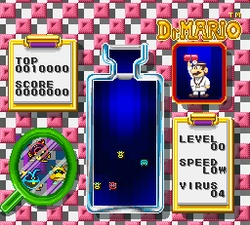
The story of Dr. Mario sprang from a simple but sharp Nintendo play: take a hero everyone knows and drop him not into a mushroomy castle, but into a lab where fire flowers become capsules and Goombas turn into grinning viruses. A doctor? Mario? It sounds odd—until the first bars of "Fever" hit and everything clicks: this is an arcade puzzler where rhythm matters as much as logic, and you’re still smiling even through the sweatiest speed duels. Hirokazu Tanaka—Hip Tanaka himself—wrote a soundtrack that sticks in your head like a capsule wedged in a narrow column, and paired with the more laid‑back "Chill" it set the game’s vibe from the very first drop.
How the idea came about — and why it worked
In the late ’80s, Nintendo was riding the puzzle boom, and the story of Dr. Mario started as an experiment: what if you take pure abstraction and give it character—pieces with personality? The viruses got colors and smirks, the capsules came in two neat halves, and Dr. Mario himself moved onto the screen—cheery, focused, like an older teammate rooting for you mid‑match. On NES and Game Boy it exploded in 1990 because it had its own cadence: not cold math, but a lively test of wits with a signature soundtrack and that perfect “one more and then bed” pull. Evening Vs. bouts around the TV became ritual: crank the virus level, max the speed, and go—who clears the bottle first, who slots that two‑tone capsule cleaner, who keeps cool when the endgame music tightens the screws.
The jump to Super Nintendo
When the 16‑bit era arrived, Dr. Mario found a new home on Super Nintendo in the Tetris & Dr. Mario cart. It felt natural: warm up with Tetris, then pop some vitamins—and the evening’s sorted. On SNES it shone brighter: bold virus colors, smooth animation, a tidy screen, and that polished “classic SNES” sheen. The sweetest twist was the crossover mode where both worlds met: stages in a single run that forced quick mental shifts—from falling tetrominoes to tight capsule logic. The competitive spark only grew stronger: two pads in Vs., "Fever" in your ears, and before you know it, half the room’s gathered to watch.
How we found Dr. Mario
Everyone took a different path to it. Some discovered it at local game clubs where Tetris & Dr. Mario sat on the party shortlist. Others rented it for the weekend—and the kitchen turned into a makeshift lab: TV hissing, mugs on the table, controllers warm, and "Chill" cheerfully looping from the speakers. The title lived on its own: sometimes Dr. Mario, sometimes just Doc Mario. Either way, everyone meant the same thing—the “virus puzzle,” where capsule halves match by color and victory always feels a move away.
Why we fell for it
The love is in the details. In the playful, cartoon tone—viruses don’t anger, they egg you on. In rules that are crystal clear at a glance, with depth that blooms as you plan paths and pop chains. In music that nudges, not nags—"Fever" and "Chill" became shorthand for the perfect match tempo. And in the comebacks: that one scramble with a chaotic stack, speed maxed, and the perfect two‑color capsule that flips everything in a single drop—those moments stick for years. It’s an arcade puzzle without the baggage: emotion hand in hand with tactics, the soundtrack working like a built‑in power‑up.
On SNES, Dr. Mario took a special spot—as a game “for the crew,” for Friday nights when you want energy without the fuss. The competition’s honest: wins are in your head, not your button mashing. That’s the ’90s Nintendo spirit—no big slogans, just warm, clever fun you show a friend in seconds. Retro memories cling like scents: hear the first notes of "Fever", the bottle glows, a capsule falls, and you’re itching to nudge the virus level higher—make it grown‑up.
Over time the series moved on, screens and systems changed, but on Super Nintendo it sits like a perfect snapshot: crisp inputs, a competitive heartbeat, an instantly readable visual language. Call it Dr. Mario or the Tetris & Dr. Mario bundle—the feeling’s the same: cozy, timeless couch competition that pulls people to the screen and makes you smile even at peak stress. It’s the kind of puzzle game where every scraped‑out win is a tiny triumph, and every loss is a reason to say “one more,” because somewhere up there the right capsule is already on its way.